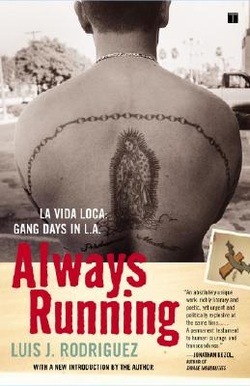
Always Running was difficult to read. Not in the sense of a difficulty in understanding, but rather a difficulty in not wanting to read. To fully read, and see, how Luis Rodriguez grew up, was so difficult. I cannot say I sympathize with him because I don't know him, and have no jurisdiction in giving any form of pity. However, I can say that I really liked this book.
Much like the quotes on the cover, I'd like to complement Rodriguez's style of writing. The poetic descriptions, matched only by the directness of the other details, gave a sort of pace to the book. There wasn't much times where I thought that it was slow. Like I stated before in the previous blog, Rodriguez switches from abstract to concrete diction, and that really adds on to the effect of being so emotionally stimulating. When I read about the injustices he faced, or the violence he encountered, I genuinely felt the anger that he was trying to convey. When Rodriguez went over his attempts at suicide, and his fears about living, I got an idea on how much pain he had been suffering though. Throughout the chapters, the constant switching between reality and obscurity was like a representation of the flurry of emotions Rodriguez was feeling growing up, and while keeping in mind how he sets paces and moods just with the manipulation of his words make them more genuine; his literature almost felt like the jazz music he listened to, free form.
As for the contents of the book, the actions he took and the choices he made, seemed like a long, long battle. Rodriguez explains how he struggled through his childhood, soon joining gangs and becoming more stronger; he is prepping himself. As the story went on, he got into more and more trouble, beating other gangs, doing drugs, sex, a whole mess of things to the point of seemingly no return; the punches become harder and rougher each swing, and each decision to act became solidified into his mentality. This all represents his internal struggle with himself, I believe. Think about it, he wanted to beat out his own weakness, to become stronger, but halfway along the climb, he slowly understands the weight of his actions. His battle was no longer one to obliterate his weakness, it became a struggle to survive from it, and he won.
All in all, I liked Rodriguez's style. It has certainly made an impact on how I want to write, and has encouraged me to continue to develop my own writing technique. The way he interweaves his memories into this piece of literature is mesmerizing, and highly respectable. I can't wait to see what we have to read next.

No comments:
Post a Comment