Thursday, September 29, 2016

Blog #4 - Always Running - Running From What?


     When it comes to literature, one of the most important things about each literary work is its title. They help distinguish each piece from another, and are often used as deciding factors when considering what to read. This is because titles always have a deeper meaning to them, giving insight on what kind of literary work it is, and sometimes even what it's about. Always Running is no different. Before I began reading, I made a guess on what the book was going to be about based solely on the title. This was in part due to me being used to TPCASTT-ing, our class's method of analyzing literature, but was mainly done because my favorite part about a story is the foreshadow used in plain sight. For this book, I made a general assumption that "always running" meant running from the past. However, in chapter two, I noticed it was more than that. As if the tragedy from the first chapter wasn't enough already, chapter two begins with a short story explaining how Grillo's childhood friend, Tino, died. It was during this scene, while Tino and Luis were running from the police, where I read the first reference to the title of the book.
   
     While Luis explains how he and Tino ran away, he reflects about this moment saying "It never stopped, this running." Afterwards, Luis elaborated on how this was so, explaining that rather that literally being chased everyday, it was more of the idea of being prey to the police, gangs, junkies, everything. It is here where I get to delve even more into the mind of Luis and his past. In his days of weakness, he felt that everything was out to get him, discriminating him for his ethnicity, judging him for his fear. The reason he was always running was because he felt that he needed the reason to run. The reference to the title is very direct too. Stated within a short simple sentence: "Always Running". By doing this, Luis invokes a deeper emotion for the reader. It's brevity could even be taken in as a tone of regret, or at least that's what it seems like for me.

Wednesday, September 28, 2016

Blog #3 - Always Running - Expecting the Worst?

   
     Within class today, my peers and I participated in a Socratic seminar, and discussed topics that were centered around the books we read so far in the curriculum. One of the topics, in particular, that was heavily elaborated on was the concept of expectations and how heavy of an impact they have on a child as they grow up. I feel that this concept was deeply portrayed in Always Running. For instance, when it came to his brother, Luis was always expected to obey and be a sort of punching bag for his brother. As kids he grew so accustomed to it, he couldn't fight back anymore, and allowed himself to be subjected to the physical abuses from his brother. Because he felt so weak as a child, you could see why Grillo wanted more power later on. He wanted to move away from the expectation that he'll always be weak, thus forming an entirely new expectation on himself; he wanted to become powerful. Furthermore, later on in the story, on his first day in school, because he couldn't understand English, his teacher had no expectation on his learning. Even as far as having no interest in teaching him, letting him sneak off to a different class. You could tell this greatly affected Luis, because he explicitly states that he knew he "wasn't wanted". This part in particular is tragic because it's something that still happens today. There are still some second language learners who aren't receiving all the education they need in this country, and aren't taken into priority for the sake of the students that already know English. It's just mind-boggling how real it is, and how despite change, remnants of the past still linger within the education system. I take into consideration that this is an autobiography, and realize that these events actually happened. I honestly feel that it's sad how large of an impact these little judgments had on Luis, very much like how they do to us as individuals, especially because it takes an even smaller amount of thought to create them.


Friday, September 23, 2016

Blog #2 - Always Running - Break Time, Several Times

     
        How words are used make up the fundamentals of literature, and is actually what we're studying about the most right now. However, when it comes down to interpreting it (when we look at words word for word), there's always more to a story than the words itself. After reading chapter one and two, breaks become more apparent. Rodriguez uses them to give the story his own sort of stylistic flair; it's a device to support literary devices. Sectioning off these memories, telling them in a non-sequential order, as stated in my previous entry, lets me, the reader, connect a bit more to the tragedy of Rodriguez. It also suggests something about the author, and how he was like. From these breaks, we can tell that Grillo was a very mentally-active, cognitive person who doesn't forget, or rather can't forget, his trauma easily.

      These breaks could also represent how Grillo feels broken off from his family, or rather lack there of. His father and mother nearly separated, he's not that close with his sisters, and his brother beats him. The schism between his family members is best seen at the beginning during the drive to the Union Train Station. Another thing these breaks could represent is the divide between social and/or racial statuses. Not only is Grillo Mexican, he's also low-class, living in Watts as proof of that. In comparison to the bike-riding white kids, he's on a whole different level; he's on a different level in mindset and values.

         In conclusion, on top of giving the text style, the breaks add a sort of a depth to Grillo's overall character. They possibly represent either his personal ideas on family, or his harsh criticism against racism and discrimination. It really adds on to the reading experience, and actually makes me want to read more. By reading his childhood first, I'll get to see his innocent-child-self turn into something else. What Grillo turned into was already established before I began the reading (he becomes gang-affiliated), but even so, Rodriguez tells his story in a way where I want to know how it happens when it first began, and how far he actually went while apart of it all.


Monday, September 19, 2016

Blog #1 - Always Running Ch. 1 -


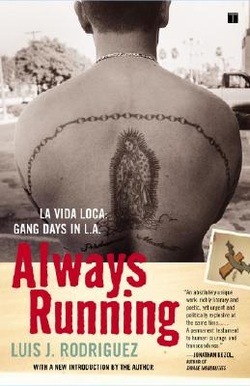
     As stated in the main page, this blog is specifically for my AP English Literature class. Therefore, throughout the curriculum other than the books I choose to read, I will also be required to read the books assigned. The first book assigned for this school year is (excluding the summer assignments), Always Running, by Luis J. Rodriguez. The first chapter begins with the narrator detailing his ride to Union train station. In it, the tense atmosphere is only matched by the diction Rodriguez uses to portray the growing distance between his "mama" and "father". Before they reach their destination, however, Grillo takes the rest of the chapter to recall all the moments that led up to this, explaining his family's history and how his life was in LA. 

     This way of structuring the chapter is what was really interesting to me though. By using flashbacks, the first scene felt a bit more tragic. Before this, they were abused and kicked out of their home, and now the family, barely, barely staying together at this point, is on the verge of separation. A moment that truly captures the tone of this depressive chapter is early on, in page fourteen where Grillo shows how he escapes into imaginary worlds to cope with all of the pressure he's being faced with in real life. When I read on about how he was beaten by his brother and the other kids, and how his parents were being torn apart, I felt that he was justified with his escapism. He was a young boy. I feel that knowing that this very much could have happened, and probably did happen to someone, gave me a deeper look into the tragedy of people back then. Does it still happen today? I can't say for certain. Furthermore, it's because I lack the understanding of this topic, I can not even begin guessing on what might happen. I can say for certain, I do worry for what might come.

Friday, September 16, 2016

Odd Thomas - Part 5: A Composition for the Book


I made this song. I'd say it matches the tone of the book quite well. Soft string harmonies to the piano lead which represents Odd's soft, cognitive nature, but a harsh chord to remind the reader about the impending doom.   


Odd Thomas - Part 4: There Was a Movie


    Before I begin, I would like to note that I didn't watch the entire movie. I stopped when the scenes became too different from the book because I didn't want to spoil anything (I didn't finish reading yet). However, deciding when to stop was quite difficult because from what I saw, the movie and the book, so far, were very, very different. To begin their contrasts, the narrator and titular character, Odd Thomas, no longer had an omniscient point of view. The movie is told in present tense, and most of what should have been description became dialogue. To be honest, this was my least favorite change between the two mediums. In comparison to the minor tweaks within other scenes, such as changing a five-year-old British kid who gets ran over into a gangster want-to-be who gets ran over, or the lack of an Elvis ghost, the dialogue comes across more awkward between characters feeling clunky, taking away from the immersion the book gave the reader. To add on to this, the atmosphere the movie gives off with the filters and acting makes the tone seem a bit too comedic. Yes, in the book, Koontz writes Odd to be sarcastic and witty, overall awkward, but in the movie, he comes across more assertive and cool (for lack of a better term). Through movie magic, they've even given him karate skills. I'm not saying that the movie is completely bad though, I haven't watched all of it yet. Moreover, concerning its shortcomings, I understand that compressing a lot of information from more than several hundred pages under a single hour and a few minutes is difficult. Honestly, it isn't as bad as I make it out to be. Different from the book, but still entertaining.


Wednesday, September 14, 2016

Odd Thomas - Part 3: Stormy Weather For Stormy?


   An interesting component to the book is the relationship between Odd Thomas and Stormy Llewellyn. She's introduced in the first chapter, but doesn't truly enter the story until Odd visits her at her job in chapter 7. But it's not what she does that makes me curious about her. Rather, it is how Odd talks about her, and describes her beliefs. When it comes to Stormy Llewellyn, Odd is meticulous and seems to have a tone full of longing. It's because of this, I assume she's going to die before the end of this book.

    To justify my hypothesis, Koontz forshadows this heavily with the use of diction and tone. Firstly, note that the perspective is not only first person, but also first-person omniscient. In context, Odd is the one writing this book and is recalling an event from the past; Odd knows what's going to happen. Knowing this, when reading any description about Stormy, the way Odd takes his time to describe everything about Stormy makes it seem like she's no longer there. Plus, whenever he refers to other characters, he doesn't state their full name like how he does with Stormy Llewellyn. At the beginning of every reference to her, Odd always states her full name. It continues the idea that he's longing for her, and supports my idea that she's no longer with him.

Tuesday, September 13, 2016

Odd Thomas - Part 2: Antagonizing Antagonists


       I am pretty well into the book, and I have got to say, one of my favorite aspects by far is the use of the obscure mythological creature, the Bodach. It is a creature of Gaelic origin, and mainly serves as their culture's bogeyman, scaring children into listening to their parents and elders. However, within these pages, the Bodach is something a little more sinister.

     What separates this Bodach from the one hiding under your bed is what it represents. An added feature to these Bodach is the fact that they gather around living people who will experience a large catastrophe or disaster. They feed off of the negative energies from these events and even relish in the suffering and death that follow. Transparent and intangible, Bodach, according to Odd, don't appear as regularly as ghosts. In spite of this, they're very dangerous when they actually do appear. A rule Koontz made against these creatures is that they cannot know you see them, otherwise they'll kill you. Because of this, Odd does his very best to avoid them finding out. Other than him, Stormy and the Police Chief know about their existence, but Odd Thomas is the only one who can see them.

    Their first appearance in the book is relatively close to the beginning. While Odd is working as a diner cook, the "Fungus Man" appears not only bringing one single Bodach, but hundreds. This is the signal for the imminent quest for Odd, because when he sees them, he knows that soon disaster will strike. Throughout the book, they're rare, but when appearing, they serve as a limitation for Odd, but a constant reminder of what he was trying to prevent. "Fungus Man" may be the physical antagonist, but most definitely, the Bodach are the true antagonists.

    I believe that the Bodach truly adds on to the Thriller aspect of the story. As mentioned before, they are constant reminders of what might happen if Odd fails, but personally, their presence within the story is very significant. The Bodach in their entirety are mysterious. Their origins aren't explained, and even Odd admits that the name "Bodach" is something he uses to refer to them; the creatures' true name isn't given. They aim for tragedy, but have no clear motive other than pleasure. What is the point? Do they work for someone or something? Where do they go when they disappear? Their obscurity perplexes me, but mostly intrigues me to find out what their true goal is. Perhaps it all will be revealed in the end, after all this is a series.