Tuesday, October 18, 2016

Final Blog - Always Running - What I Learned


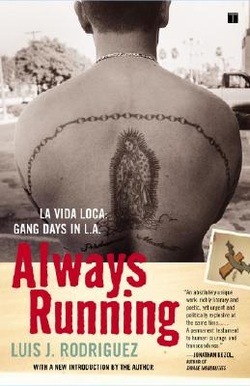
      After reading Always Running, I got a better understanding on how environment can affect mentality growth. I mean, I always knew that it was a thing, but after this book, I can get a better grasp at the concept. Also, it was amazing to read, and interesting to see the inter-systems of these gangs and their philosophies. What I know is that, this wasn't a rags-to-riches autobiography. It was a detailed explanation on the intricate inner mechanisms of factors of factors that led Rodriguez into la vida loca. It was a list of all the memories and regrets Rodriguez has, and has reinforced my ideology on forgoing presumed judgements because you can never really tell what a person has been through.         Apart from the other books I've read at school (Flowers For Algernon and Of Mice and Men to name a few), this book didn't really finalize its feeling of depression and gloom. It was all-round melancholic, but never-the-less gave a larger feeling of hope. Here we had an author who poured his heart out, describing how he had to face violence and terror everyday at such a young age, but still managed to find himself amongst the chaos, and seek education, and a life away from all of that. At the end when Rodriguez finally moves on from his life as Chin, I can see that he finally stopped running.

Monday, October 17, 2016

Blog #9 - Always Running - In Memoriam to Another Book: A Review


       Always Running was difficult to read. Not in the sense of a difficulty in understanding, but rather a difficulty in not wanting to read. To fully read, and see, how Luis Rodriguez grew up, was so difficult. I cannot say I sympathize with him because I don't know him, and have no jurisdiction in giving any form of pity. However, I can say that I really liked this book.
      Much like the quotes on the cover, I'd like to complement Rodriguez's style of writing. The poetic descriptions, matched only by the directness of the other details, gave a sort of pace to the book. There wasn't much times where I thought that it was slow. Like I stated before in the previous blog, Rodriguez switches from abstract to concrete diction, and that really adds on to the effect of being so emotionally stimulating. When I read about the injustices he faced, or the violence he encountered, I genuinely felt the anger that he was trying to convey. When Rodriguez went over his attempts at suicide, and his fears about living, I got an idea on how much pain he had been suffering though. Throughout the chapters, the constant switching between reality and obscurity was like a representation of the flurry of emotions Rodriguez was feeling growing up, and while keeping in mind how he sets paces and moods just with the manipulation of his words make them more genuine; his literature almost felt like the jazz music he listened to, free form.
     As for the contents of the book, the actions he took and the choices he made, seemed like a long, long battle. Rodriguez explains how he struggled through his childhood, soon joining gangs and becoming more stronger; he is prepping himself. As the story went on, he got into more and more trouble, beating other gangs, doing drugs, sex, a whole mess of things to the point of seemingly no return; the punches become harder and rougher each swing, and each decision to act became solidified into his mentality. This all represents his internal struggle with himself, I believe. Think about it, he wanted to beat out his own weakness, to become stronger, but halfway along the climb, he slowly understands the weight of his actions. His battle was no longer one to obliterate his weakness, it became a struggle to survive from it, and he won.
     All in all, I liked Rodriguez's style. It has certainly made an impact on how I want to write, and has encouraged me to continue to develop my own writing technique. The way he interweaves his memories into this piece of literature is mesmerizing, and highly respectable. I can't wait to see what we have to read next.

Friday, October 7, 2016

Blog #8 - Always Running - Part 3 of Song: The Song


     This is the end result of the song I wrote for Always Running. A simple acoustic song with plucks and strums influenced by Mexican music.

Blog #7 - Always Running - Part 2 of Song: The Title of the Piece


      In the previous blog, I explained my thought process as I wrote the song. However, the one thing I didn't talk about was the title of the song. That's because I wanted to elaborate on it, and its significance. Usually when I write songs, I make a title, then write lyrics based on it and the themes it represents. This song it no different.

     I named the song: "Repress, Repress, Regret". Although it may seem simple, there was a lot of thought that went into this. Firstly, the title alludes to a medical acronym, RRR, which means Regular Rate and Rhythm (in regards to measuring heartbeats). In the song, I tried to imitate this idea of a heartbeat because blood is significant in Always Running, whether it refers to the denotation or the implication of family. In other words, I made RRR represent the violence and falling out of familial ties that occur throughout the book.

    Next, focusing on the actual words, I chose "repress" and "regret" because that how I feel Rodriguez describes himself in the books. The first "repress" is how he feels repressed by everything, "Society", "racism" and "wealth" to name a few. This is explored explicitly though his details on events that occurred in his childhood, through the violence he's lived through. The second "repress" represents how he tries to repress his past and his weakness which is show by his constant prone to violence and his slumps of desperation which led to suicidal thoughts. The "regret" is exactly how it is, representing his regrets in the book.


Blog #6 - Always Running - Part 1 of Song: The Meaning in the Lyrics


These dark thoughts are circulating again in my head
As the music gets louder, the light's drawing closer and yet
When I take a moment to look back at life and reflect
Recollection betrays me and shows only what I regret

The crimson that's falling down and
The sea of doubt that surrounds
Pull me back again
'Til I fall again

Strength is what I wanted
Strength is what I need
I'm not ever going back to the man I was before

I can't distinguish the nightmares from reality
Especially when you're a no one in society

The dichotomy that exists, and
All the people that I miss
Pull me back again
Torture me again
(Pull me back to torture me again)

Strength is what I wanted
Strength is what I need
I'm not ever going back to the man I was before,
Not when I have to stand up and fight on in this war

Bury me in pleasure, bury me in liquor
(Repress, Repress, Regret)
Bury me in sorrow, bury me in requiem
(Repress, Repress, Regret)
I'm not sorry I'm not who you want me to be (I'm not sorry)
I'm not sorry and I'm not ever gonna be (Gonna Be)

Strength is what I wanted
Strength is what I need
I'm not ever going back to the man I was before,
Not when I have to stand up and fight on in this war
Called Life
-------------------------------------------------------------------
       After reading this book for awhile, I started to find a sort of connection with the book. As it progresses, I begin to understand why he sought out power, why he wanted to be the manifestation of this ideal man not affected by any of the cruelties of reality. However, I also see how his climb towards the peak is always getting interrupted by what he was running away from in the first place. Hence, a cycle where he continues to run away from his weakness, only to be confronted by it again; he's Always Running.  

     In these lyrics, I tried my best to portray that, while playing off of the abstract and concrete diction Rodriguez uses in his book. Notice how the lyrics start off abstract, but continues to become more and more concrete. I did this to symbolize how Luis starts to realize how what he's doing is causing his own self-destruction. At the bridge ("bury me..."), I made it to symbolize his internal struggle as he confronts himself, because on one hand he's doing whatever he can to become stronger, but on the other hand, he's continuously hurting the ones he's caring about.

   Another thing I did was build onto the chorus each time it's sung. This was, in part, due to continue the "abstract to concrete" thing, but the main reason I did this was to represent his growth as a person. It begins with a reminder of who he doesn't want to be; Luis wants to become stronger. Then, it goes off to explain how he sought power; he got involved with gangs and fought against many people. Finally, the last chorus represents his doubts, or rather, his realization that his actions have weight to them.


Tuesday, October 4, 2016

Blog #5 - Always Running - A Fast Break for Luis


       I found another thing that I really like about Rodriguez's writing style: his abstract flow of words. One of the language tools we're currently honing in class is diction, and in a recent test we focused on how Rodriguez manipulates his words to perfectly describe the raw emotion in the memories displayed in the book. There are times where he tells things as it is, explicitly sparing no detail, but there are times where he uses abstract detail to emphasize a certain feeling in particular scenes. One of these moments that I'd like to focus on is at the end of chapter four.

       At this moment in time, Luis feels guilty about breaking up with his then girlfriend, Payasa, who subsequently got herself seriously injured while under the influence. Before going off to break into another scene, Rodriguez ends this section with Payasa's brother, Wilo, simply stating: "That's Payasa, man." The importance of this simple statement, which references the same statement said earlier in the chapter, is that it gives a sense of finality. Although it could be seen as Wilo comforting Luis, the way Rodriguez repeats this line, and makes it stand alone in it's own small paragraph, implies that he was trying to take blame for what happened. This sets up a more darker atmosphere for what happens next.

    After the break, Rodriguez explains how he attempted suicide. However, he doesn't tell you straight out. Within this moment, he compares the act with music that's getting "louder" and won't "let up". His words become abstract as he describes this memory, symbolic to how lost he's feeling. He soon gets snapped into life when he's saved by Wilo and Baba, which at that point, his words start to take back their literal form.
   
     The following paragraph describes how he's accepted back into the house after showing his mother a small bit of humility. Unlike the previous scenes, the sentences are shortened, and describe simple actions. These shortened sentences add a sort of relief of sorts, but still have a sense about them as if they were just dreams. By doing this, Rodriguez implies that despite this short break, he's still looking for his own worth. A search that will definitely call for more mistakes.


Thursday, September 29, 2016

Blog #4 - Always Running - Running From What?


     When it comes to literature, one of the most important things about each literary work is its title. They help distinguish each piece from another, and are often used as deciding factors when considering what to read. This is because titles always have a deeper meaning to them, giving insight on what kind of literary work it is, and sometimes even what it's about. Always Running is no different. Before I began reading, I made a guess on what the book was going to be about based solely on the title. This was in part due to me being used to TPCASTT-ing, our class's method of analyzing literature, but was mainly done because my favorite part about a story is the foreshadow used in plain sight. For this book, I made a general assumption that "always running" meant running from the past. However, in chapter two, I noticed it was more than that. As if the tragedy from the first chapter wasn't enough already, chapter two begins with a short story explaining how Grillo's childhood friend, Tino, died. It was during this scene, while Tino and Luis were running from the police, where I read the first reference to the title of the book.
   
     While Luis explains how he and Tino ran away, he reflects about this moment saying "It never stopped, this running." Afterwards, Luis elaborated on how this was so, explaining that rather that literally being chased everyday, it was more of the idea of being prey to the police, gangs, junkies, everything. It is here where I get to delve even more into the mind of Luis and his past. In his days of weakness, he felt that everything was out to get him, discriminating him for his ethnicity, judging him for his fear. The reason he was always running was because he felt that he needed the reason to run. The reference to the title is very direct too. Stated within a short simple sentence: "Always Running". By doing this, Luis invokes a deeper emotion for the reader. It's brevity could even be taken in as a tone of regret, or at least that's what it seems like for me.

Wednesday, September 28, 2016

Blog #3 - Always Running - Expecting the Worst?

   
     Within class today, my peers and I participated in a Socratic seminar, and discussed topics that were centered around the books we read so far in the curriculum. One of the topics, in particular, that was heavily elaborated on was the concept of expectations and how heavy of an impact they have on a child as they grow up. I feel that this concept was deeply portrayed in Always Running. For instance, when it came to his brother, Luis was always expected to obey and be a sort of punching bag for his brother. As kids he grew so accustomed to it, he couldn't fight back anymore, and allowed himself to be subjected to the physical abuses from his brother. Because he felt so weak as a child, you could see why Grillo wanted more power later on. He wanted to move away from the expectation that he'll always be weak, thus forming an entirely new expectation on himself; he wanted to become powerful. Furthermore, later on in the story, on his first day in school, because he couldn't understand English, his teacher had no expectation on his learning. Even as far as having no interest in teaching him, letting him sneak off to a different class. You could tell this greatly affected Luis, because he explicitly states that he knew he "wasn't wanted". This part in particular is tragic because it's something that still happens today. There are still some second language learners who aren't receiving all the education they need in this country, and aren't taken into priority for the sake of the students that already know English. It's just mind-boggling how real it is, and how despite change, remnants of the past still linger within the education system. I take into consideration that this is an autobiography, and realize that these events actually happened. I honestly feel that it's sad how large of an impact these little judgments had on Luis, very much like how they do to us as individuals, especially because it takes an even smaller amount of thought to create them.


Friday, September 23, 2016

Blog #2 - Always Running - Break Time, Several Times

     
        How words are used make up the fundamentals of literature, and is actually what we're studying about the most right now. However, when it comes down to interpreting it (when we look at words word for word), there's always more to a story than the words itself. After reading chapter one and two, breaks become more apparent. Rodriguez uses them to give the story his own sort of stylistic flair; it's a device to support literary devices. Sectioning off these memories, telling them in a non-sequential order, as stated in my previous entry, lets me, the reader, connect a bit more to the tragedy of Rodriguez. It also suggests something about the author, and how he was like. From these breaks, we can tell that Grillo was a very mentally-active, cognitive person who doesn't forget, or rather can't forget, his trauma easily.

      These breaks could also represent how Grillo feels broken off from his family, or rather lack there of. His father and mother nearly separated, he's not that close with his sisters, and his brother beats him. The schism between his family members is best seen at the beginning during the drive to the Union Train Station. Another thing these breaks could represent is the divide between social and/or racial statuses. Not only is Grillo Mexican, he's also low-class, living in Watts as proof of that. In comparison to the bike-riding white kids, he's on a whole different level; he's on a different level in mindset and values.

         In conclusion, on top of giving the text style, the breaks add a sort of a depth to Grillo's overall character. They possibly represent either his personal ideas on family, or his harsh criticism against racism and discrimination. It really adds on to the reading experience, and actually makes me want to read more. By reading his childhood first, I'll get to see his innocent-child-self turn into something else. What Grillo turned into was already established before I began the reading (he becomes gang-affiliated), but even so, Rodriguez tells his story in a way where I want to know how it happens when it first began, and how far he actually went while apart of it all.


Monday, September 19, 2016

Blog #1 - Always Running Ch. 1 -


     As stated in the main page, this blog is specifically for my AP English Literature class. Therefore, throughout the curriculum other than the books I choose to read, I will also be required to read the books assigned. The first book assigned for this school year is (excluding the summer assignments), Always Running, by Luis J. Rodriguez. The first chapter begins with the narrator detailing his ride to Union train station. In it, the tense atmosphere is only matched by the diction Rodriguez uses to portray the growing distance between his "mama" and "father". Before they reach their destination, however, Grillo takes the rest of the chapter to recall all the moments that led up to this, explaining his family's history and how his life was in LA. 

     This way of structuring the chapter is what was really interesting to me though. By using flashbacks, the first scene felt a bit more tragic. Before this, they were abused and kicked out of their home, and now the family, barely, barely staying together at this point, is on the verge of separation. A moment that truly captures the tone of this depressive chapter is early on, in page fourteen where Grillo shows how he escapes into imaginary worlds to cope with all of the pressure he's being faced with in real life. When I read on about how he was beaten by his brother and the other kids, and how his parents were being torn apart, I felt that he was justified with his escapism. He was a young boy. I feel that knowing that this very much could have happened, and probably did happen to someone, gave me a deeper look into the tragedy of people back then. Does it still happen today? I can't say for certain. Furthermore, it's because I lack the understanding of this topic, I can not even begin guessing on what might happen. I can say for certain, I do worry for what might come.

Friday, September 16, 2016

Odd Thomas - Part 5: A Composition for the Book


I made this song. I'd say it matches the tone of the book quite well. Soft string harmonies to the piano lead which represents Odd's soft, cognitive nature, but a harsh chord to remind the reader about the impending doom.   


Odd Thomas - Part 4: There Was a Movie


    Before I begin, I would like to note that I didn't watch the entire movie. I stopped when the scenes became too different from the book because I didn't want to spoil anything (I didn't finish reading yet). However, deciding when to stop was quite difficult because from what I saw, the movie and the book, so far, were very, very different. To begin their contrasts, the narrator and titular character, Odd Thomas, no longer had an omniscient point of view. The movie is told in present tense, and most of what should have been description became dialogue. To be honest, this was my least favorite change between the two mediums. In comparison to the minor tweaks within other scenes, such as changing a five-year-old British kid who gets ran over into a gangster want-to-be who gets ran over, or the lack of an Elvis ghost, the dialogue comes across more awkward between characters feeling clunky, taking away from the immersion the book gave the reader. To add on to this, the atmosphere the movie gives off with the filters and acting makes the tone seem a bit too comedic. Yes, in the book, Koontz writes Odd to be sarcastic and witty, overall awkward, but in the movie, he comes across more assertive and cool (for lack of a better term). Through movie magic, they've even given him karate skills. I'm not saying that the movie is completely bad though, I haven't watched all of it yet. Moreover, concerning its shortcomings, I understand that compressing a lot of information from more than several hundred pages under a single hour and a few minutes is difficult. Honestly, it isn't as bad as I make it out to be. Different from the book, but still entertaining.


Wednesday, September 14, 2016

Odd Thomas - Part 3: Stormy Weather For Stormy?


   An interesting component to the book is the relationship between Odd Thomas and Stormy Llewellyn. She's introduced in the first chapter, but doesn't truly enter the story until Odd visits her at her job in chapter 7. But it's not what she does that makes me curious about her. Rather, it is how Odd talks about her, and describes her beliefs. When it comes to Stormy Llewellyn, Odd is meticulous and seems to have a tone full of longing. It's because of this, I assume she's going to die before the end of this book.

    To justify my hypothesis, Koontz forshadows this heavily with the use of diction and tone. Firstly, note that the perspective is not only first person, but also first-person omniscient. In context, Odd is the one writing this book and is recalling an event from the past; Odd knows what's going to happen. Knowing this, when reading any description about Stormy, the way Odd takes his time to describe everything about Stormy makes it seem like she's no longer there. Plus, whenever he refers to other characters, he doesn't state their full name like how he does with Stormy Llewellyn. At the beginning of every reference to her, Odd always states her full name. It continues the idea that he's longing for her, and supports my idea that she's no longer with him.

Tuesday, September 13, 2016

Odd Thomas - Part 2: Antagonizing Antagonists


       I am pretty well into the book, and I have got to say, one of my favorite aspects by far is the use of the obscure mythological creature, the Bodach. It is a creature of Gaelic origin, and mainly serves as their culture's bogeyman, scaring children into listening to their parents and elders. However, within these pages, the Bodach is something a little more sinister.

     What separates this Bodach from the one hiding under your bed is what it represents. An added feature to these Bodach is the fact that they gather around living people who will experience a large catastrophe or disaster. They feed off of the negative energies from these events and even relish in the suffering and death that follow. Transparent and intangible, Bodach, according to Odd, don't appear as regularly as ghosts. In spite of this, they're very dangerous when they actually do appear. A rule Koontz made against these creatures is that they cannot know you see them, otherwise they'll kill you. Because of this, Odd does his very best to avoid them finding out. Other than him, Stormy and the Police Chief know about their existence, but Odd Thomas is the only one who can see them.

    Their first appearance in the book is relatively close to the beginning. While Odd is working as a diner cook, the "Fungus Man" appears not only bringing one single Bodach, but hundreds. This is the signal for the imminent quest for Odd, because when he sees them, he knows that soon disaster will strike. Throughout the book, they're rare, but when appearing, they serve as a limitation for Odd, but a constant reminder of what he was trying to prevent. "Fungus Man" may be the physical antagonist, but most definitely, the Bodach are the true antagonists.

    I believe that the Bodach truly adds on to the Thriller aspect of the story. As mentioned before, they are constant reminders of what might happen if Odd fails, but personally, their presence within the story is very significant. The Bodach in their entirety are mysterious. Their origins aren't explained, and even Odd admits that the name "Bodach" is something he uses to refer to them; the creatures' true name isn't given. They aim for tragedy, but have no clear motive other than pleasure. What is the point? Do they work for someone or something? Where do they go when they disappear? Their obscurity perplexes me, but mostly intrigues me to find out what their true goal is. Perhaps it all will be revealed in the end, after all this is a series.


Wednesday, August 24, 2016

Odd Thomas - Part 1: The Introduction


   To begin my re-ascension into the world of literature, I picked up a book from a completely secret location that stores books you've probably never heard of: my mom's library shelf. To be honest, I did not know what I was getting into at the time, and considering the fact that I chose it based on instinct alone, my blind venture was one taken with an initial reluctance. I've never read a Dean Koontz book before, much less even heard what most of them were about. I knew he wrote thriller, but that was just about it. That being said, I am surprised what I found. However, what I want to talk about the most right now is Dean Koontz's uses of heavy, implied foreshadowing.

   Firstly, before I get into the actual context of the book's story, I would like to take a moment to refer to the dedication page, and a page that contains a single, lone quote. When Koontz dedicates this book to the ones he refers to as the "Old Girls", he follows up with lines that imply that he want's to meet up with them, but he does so in a way that's rather Odd. He states:

 "We'll get together. We'll nosh [eat]. We'll tipple [drink alcohol]. We'll dish, dish, dish." 

   In a place where authors usually get informal to spread their gratitude to their supporters and friends, Koontz takes the time to make it sound poetic. I find this part important because it introduced me to Koontz's style of writing. Instead of saying it in a way people would normally do, he uses more obscure words which heighten the rhythmic feel to it, and gives an underlying feeling of mystery and intensity. Moreover, there's the repeating "dish, dish, dish" which I found out could mean one of three things: to gossip, to utterly destroy something or someone, or both. The capability of broad interpretation is a style easily found in this book, but the point is that this all means something. This diction implies that we're going to be delving into obscure ideas and concepts.

  Next, is the lone quote, on the following page, which states: 

"Hope requires the contender
Who sees no virtue in surrender.
From the cradle to the bier,
The heart must persevere."

    When I read the credit line, I was met with the title: "The Book of Counted Joys". However, after further investigation, I've discovered that not only did the book not exist, it was a "book" that Koontz referred to in his other books. Therefore, my interpretation of this quote is that it the theme of the book. It is foreshadowing that the main character will face countless trials where he must have the sufficient determination to pull through. Moreover, it gives a sense of mortality with its third line. A bier is another word for a coffin. This negative connotation adds on to the tone that's true to the book's nature; it's an adult thriller-fiction. Will someone die? Will the main character give up? These are the questions I had going into the book. Another thing that I want to point out is the fact that this quote was by itself on the page it was founded on. The extra space could represent emptiness, or loneliness, contrasting with the idea of hope presented here. This antithesis shows a more human side to the quote because the ideal thing is to move on, to persevere, but as we do so, we're still going to have these negative feelings that will stay with us.

   Moving on, within the first chapter, simply titled: "One", Koontz starts off introducing the main character: Odd Thomas. This is done through use of first-person perspective, and in doing so, it allowed me to identify with the personality of the character. Immediately after introducing himself, Odd Thomas shrugs off his entire existence as "not important", questioning why you should even care about him in the first place. However, following this line, is a series of explanations that show that the "current" him is going to be recalling events from the past. As what made him become such a hollowed soul, is to be determined, but like before it's foreshadow. It's in the way Odd Thomas conveyed his motives for recollection through the following phrase:

"...I'm not writing this for money. I am writing it to save my sanity and to discover if I can convince myself that my life has purpose and meaning enough to justify continued existence."

   What made him think that his sanity was gone? This, added on to the dark atmosphere already present before the book even started, only leads to even more darker thoughts.

   As I conclude, I would like to say that so far I'm enjoying the book. I just wanted to share interesting things I found at the very beginning. I've discovered that it isn't only a thriller, and that some of my inferences have taken a direct hit, but I will discuss those in a later post. I do warn you though, as I continue with the next posts, there will be spoilers. So if you really want to fully enjoy this thread, please read the book first. I highly recommend it. Do be careful though, there are some strong adult themes. That said, have a nice day, and thanks for reading!