Tuesday, October 18, 2016

Final Blog - Always Running - What I Learned


      After reading Always Running, I got a better understanding on how environment can affect mentality growth. I mean, I always knew that it was a thing, but after this book, I can get a better grasp at the concept. Also, it was amazing to read, and interesting to see the inter-systems of these gangs and their philosophies. What I know is that, this wasn't a rags-to-riches autobiography. It was a detailed explanation on the intricate inner mechanisms of factors of factors that led Rodriguez into la vida loca. It was a list of all the memories and regrets Rodriguez has, and has reinforced my ideology on forgoing presumed judgements because you can never really tell what a person has been through.         Apart from the other books I've read at school (Flowers For Algernon and Of Mice and Men to name a few), this book didn't really finalize its feeling of depression and gloom. It was all-round melancholic, but never-the-less gave a larger feeling of hope. Here we had an author who poured his heart out, describing how he had to face violence and terror everyday at such a young age, but still managed to find himself amongst the chaos, and seek education, and a life away from all of that. At the end when Rodriguez finally moves on from his life as Chin, I can see that he finally stopped running.

Monday, October 17, 2016

Blog #9 - Always Running - In Memoriam to Another Book: A Review


       Always Running was difficult to read. Not in the sense of a difficulty in understanding, but rather a difficulty in not wanting to read. To fully read, and see, how Luis Rodriguez grew up, was so difficult. I cannot say I sympathize with him because I don't know him, and have no jurisdiction in giving any form of pity. However, I can say that I really liked this book.
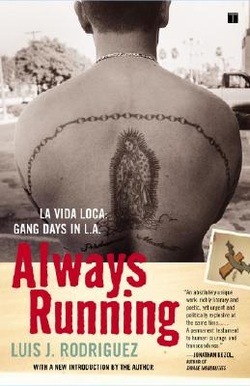
      Much like the quotes on the cover, I'd like to complement Rodriguez's style of writing. The poetic descriptions, matched only by the directness of the other details, gave a sort of pace to the book. There wasn't much times where I thought that it was slow. Like I stated before in the previous blog, Rodriguez switches from abstract to concrete diction, and that really adds on to the effect of being so emotionally stimulating. When I read about the injustices he faced, or the violence he encountered, I genuinely felt the anger that he was trying to convey. When Rodriguez went over his attempts at suicide, and his fears about living, I got an idea on how much pain he had been suffering though. Throughout the chapters, the constant switching between reality and obscurity was like a representation of the flurry of emotions Rodriguez was feeling growing up, and while keeping in mind how he sets paces and moods just with the manipulation of his words make them more genuine; his literature almost felt like the jazz music he listened to, free form.
     As for the contents of the book, the actions he took and the choices he made, seemed like a long, long battle. Rodriguez explains how he struggled through his childhood, soon joining gangs and becoming more stronger; he is prepping himself. As the story went on, he got into more and more trouble, beating other gangs, doing drugs, sex, a whole mess of things to the point of seemingly no return; the punches become harder and rougher each swing, and each decision to act became solidified into his mentality. This all represents his internal struggle with himself, I believe. Think about it, he wanted to beat out his own weakness, to become stronger, but halfway along the climb, he slowly understands the weight of his actions. His battle was no longer one to obliterate his weakness, it became a struggle to survive from it, and he won.
     All in all, I liked Rodriguez's style. It has certainly made an impact on how I want to write, and has encouraged me to continue to develop my own writing technique. The way he interweaves his memories into this piece of literature is mesmerizing, and highly respectable. I can't wait to see what we have to read next.

Friday, October 7, 2016

Blog #8 - Always Running - Part 3 of Song: The Song


     This is the end result of the song I wrote for Always Running. A simple acoustic song with plucks and strums influenced by Mexican music.

Blog #7 - Always Running - Part 2 of Song: The Title of the Piece


      In the previous blog, I explained my thought process as I wrote the song. However, the one thing I didn't talk about was the title of the song. That's because I wanted to elaborate on it, and its significance. Usually when I write songs, I make a title, then write lyrics based on it and the themes it represents. This song it no different.

     I named the song: "Repress, Repress, Regret". Although it may seem simple, there was a lot of thought that went into this. Firstly, the title alludes to a medical acronym, RRR, which means Regular Rate and Rhythm (in regards to measuring heartbeats). In the song, I tried to imitate this idea of a heartbeat because blood is significant in Always Running, whether it refers to the denotation or the implication of family. In other words, I made RRR represent the violence and falling out of familial ties that occur throughout the book.

    Next, focusing on the actual words, I chose "repress" and "regret" because that how I feel Rodriguez describes himself in the books. The first "repress" is how he feels repressed by everything, "Society", "racism" and "wealth" to name a few. This is explored explicitly though his details on events that occurred in his childhood, through the violence he's lived through. The second "repress" represents how he tries to repress his past and his weakness which is show by his constant prone to violence and his slumps of desperation which led to suicidal thoughts. The "regret" is exactly how it is, representing his regrets in the book.


Blog #6 - Always Running - Part 1 of Song: The Meaning in the Lyrics


These dark thoughts are circulating again in my head
As the music gets louder, the light's drawing closer and yet
When I take a moment to look back at life and reflect
Recollection betrays me and shows only what I regret

The crimson that's falling down and
The sea of doubt that surrounds
Pull me back again
'Til I fall again

Strength is what I wanted
Strength is what I need
I'm not ever going back to the man I was before

I can't distinguish the nightmares from reality
Especially when you're a no one in society

The dichotomy that exists, and
All the people that I miss
Pull me back again
Torture me again
(Pull me back to torture me again)

Strength is what I wanted
Strength is what I need
I'm not ever going back to the man I was before,
Not when I have to stand up and fight on in this war

Bury me in pleasure, bury me in liquor
(Repress, Repress, Regret)
Bury me in sorrow, bury me in requiem
(Repress, Repress, Regret)
I'm not sorry I'm not who you want me to be (I'm not sorry)
I'm not sorry and I'm not ever gonna be (Gonna Be)

Strength is what I wanted
Strength is what I need
I'm not ever going back to the man I was before,
Not when I have to stand up and fight on in this war
Called Life
-------------------------------------------------------------------
       After reading this book for awhile, I started to find a sort of connection with the book. As it progresses, I begin to understand why he sought out power, why he wanted to be the manifestation of this ideal man not affected by any of the cruelties of reality. However, I also see how his climb towards the peak is always getting interrupted by what he was running away from in the first place. Hence, a cycle where he continues to run away from his weakness, only to be confronted by it again; he's Always Running.  

     In these lyrics, I tried my best to portray that, while playing off of the abstract and concrete diction Rodriguez uses in his book. Notice how the lyrics start off abstract, but continues to become more and more concrete. I did this to symbolize how Luis starts to realize how what he's doing is causing his own self-destruction. At the bridge ("bury me..."), I made it to symbolize his internal struggle as he confronts himself, because on one hand he's doing whatever he can to become stronger, but on the other hand, he's continuously hurting the ones he's caring about.

   Another thing I did was build onto the chorus each time it's sung. This was, in part, due to continue the "abstract to concrete" thing, but the main reason I did this was to represent his growth as a person. It begins with a reminder of who he doesn't want to be; Luis wants to become stronger. Then, it goes off to explain how he sought power; he got involved with gangs and fought against many people. Finally, the last chorus represents his doubts, or rather, his realization that his actions have weight to them.


Tuesday, October 4, 2016

Blog #5 - Always Running - A Fast Break for Luis


       I found another thing that I really like about Rodriguez's writing style: his abstract flow of words. One of the language tools we're currently honing in class is diction, and in a recent test we focused on how Rodriguez manipulates his words to perfectly describe the raw emotion in the memories displayed in the book. There are times where he tells things as it is, explicitly sparing no detail, but there are times where he uses abstract detail to emphasize a certain feeling in particular scenes. One of these moments that I'd like to focus on is at the end of chapter four.

       At this moment in time, Luis feels guilty about breaking up with his then girlfriend, Payasa, who subsequently got herself seriously injured while under the influence. Before going off to break into another scene, Rodriguez ends this section with Payasa's brother, Wilo, simply stating: "That's Payasa, man." The importance of this simple statement, which references the same statement said earlier in the chapter, is that it gives a sense of finality. Although it could be seen as Wilo comforting Luis, the way Rodriguez repeats this line, and makes it stand alone in it's own small paragraph, implies that he was trying to take blame for what happened. This sets up a more darker atmosphere for what happens next.

    After the break, Rodriguez explains how he attempted suicide. However, he doesn't tell you straight out. Within this moment, he compares the act with music that's getting "louder" and won't "let up". His words become abstract as he describes this memory, symbolic to how lost he's feeling. He soon gets snapped into life when he's saved by Wilo and Baba, which at that point, his words start to take back their literal form.
   
     The following paragraph describes how he's accepted back into the house after showing his mother a small bit of humility. Unlike the previous scenes, the sentences are shortened, and describe simple actions. These shortened sentences add a sort of relief of sorts, but still have a sense about them as if they were just dreams. By doing this, Rodriguez implies that despite this short break, he's still looking for his own worth. A search that will definitely call for more mistakes.


Thursday, September 29, 2016

Blog #4 - Always Running - Running From What?


     When it comes to literature, one of the most important things about each literary work is its title. They help distinguish each piece from another, and are often used as deciding factors when considering what to read. This is because titles always have a deeper meaning to them, giving insight on what kind of literary work it is, and sometimes even what it's about. Always Running is no different. Before I began reading, I made a guess on what the book was going to be about based solely on the title. This was in part due to me being used to TPCASTT-ing, our class's method of analyzing literature, but was mainly done because my favorite part about a story is the foreshadow used in plain sight. For this book, I made a general assumption that "always running" meant running from the past. However, in chapter two, I noticed it was more than that. As if the tragedy from the first chapter wasn't enough already, chapter two begins with a short story explaining how Grillo's childhood friend, Tino, died. It was during this scene, while Tino and Luis were running from the police, where I read the first reference to the title of the book.
   
     While Luis explains how he and Tino ran away, he reflects about this moment saying "It never stopped, this running." Afterwards, Luis elaborated on how this was so, explaining that rather that literally being chased everyday, it was more of the idea of being prey to the police, gangs, junkies, everything. It is here where I get to delve even more into the mind of Luis and his past. In his days of weakness, he felt that everything was out to get him, discriminating him for his ethnicity, judging him for his fear. The reason he was always running was because he felt that he needed the reason to run. The reference to the title is very direct too. Stated within a short simple sentence: "Always Running". By doing this, Luis invokes a deeper emotion for the reader. It's brevity could even be taken in as a tone of regret, or at least that's what it seems like for me.